
Emergency Air Duct Cleaning Near Me: What Castro Valley Homeowners Should Do First
If you’re searching for emergency air duct cleaning near you in Castro Valley, the first move is to shut your HVAC system off at the thermostat, then figure out whether you’re dealing with a true contamination event or something that just smells bad. True emergencies (post-flood water, sewage backup, confirmed rodent activity, smoke damage from a fire) warrant same-day service with HEPA extraction and antimicrobial treatment. A sudden musty smell or extra dust on the registers, while unpleasant, can usually wait a few days for a scheduled appointment. If you’d rather not sort this out alone, call (855) 382-9257 and describe what you’re seeing. We answer 24/7.
The Two Categories of “Duct Emergencies” in Castro Valley
Most calls we get from homeowners in Castro Valley who describe their situation as a duct emergency fall into one of two buckets. The first bucket is genuinely urgent: water has entered the ductwork, sewage has backed up into the system, a rodent has died or nested inside, or smoke from a kitchen or house fire has been pulled through the returns and distributed throughout the home. These are contamination events. They require immediate shutdown of the HVAC system and a specific cleaning protocol that goes beyond standard maintenance.
The second bucket is alarming but not urgent. A smell that appeared suddenly, a layer of dust you noticed on the supply registers, or allergy symptoms that seem worse this week all feel like emergencies when you’re living inside them. These conditions deserve attention, but they don’t require pulling a crew off another job the same day. Scheduling a thorough air duct cleaning within a few days gets you the same result without an emergency response you didn’t need.
The reason this distinction matters is simple: acting on the wrong category either wastes effort or delays a real fix. Rushing a crew out for dusty registers gains nothing over a scheduled visit. Waiting three days on a sewage-contaminated return plenum makes the problem worse every hour the system runs. Here’s a quick decision tree:
- Water entered the ducts (flood, leak, overflow): True emergency. Shut the system down. Call immediately.
- Sewage backed up into a floor register or the return: True emergency. Shut the system down. Call immediately.
- You found a dead rodent or clear evidence of nesting in the ducts: True emergency. Shut the system down. Call immediately.
- Smoke from a fire moved through the HVAC system: True emergency. Shut the system down. Call immediately.
- Sudden musty or sour smell, no known water source: Not urgent. Schedule within the week.
- Visible dust on registers, allergies flaring, house feels stuffy: Not urgent. Schedule a standard cleaning.
- You just bought or renovated an older Castro Valley home and have no idea what’s in the ducts: Not urgent, but worth scheduling sooner rather than later.
What to Do Before the Technician Arrives
Once you’ve determined that you’re in the true-emergency category, there are four immediate steps to take before any cleaning crew shows up at your Castro Valley home. These steps protect your family and prevent the contamination from spreading further through the living space.
First, shut the HVAC system down at the thermostat. Set it to “off” and if you have a smart thermostat, disable any scheduled programs so it doesn’t kick back on automatically. Every cycle of the blower pushes contaminated air through the supply ducts and into the rooms where you sleep and eat. Turning the system off stops that distribution loop.
Second, do not run ceiling fans, bathroom exhaust fans, or portable fans in the affected area. It’s a natural instinct to ventilate, but moving air around contaminated ductwork stirs particulates into the room instead of containing them. Let the air settle and stay still until the crew arrives with proper containment equipment.
Third, resist the urge to remove a register cover and vacuum out what you can see. It will not help. Household vacuums lack the filtration needed to capture what’s inside ductwork, and pulling debris toward the register opening just spreads contamination across the floor and into the room air. Leave the registers alone.
Fourth, skip the aerosol duct sprays and deodorizers sold at hardware stores. These products mask smells without removing the source, and some leave a residue inside the ductwork that makes proper cleaning more difficult later. A true contamination event needs physical removal of the contaminant, not a fragrance cover-up.
What “Emergency Duct Cleaning” Actually Requires
Here’s where the technical reality separates a legitimate Duct Cleaning Castro Valley emergency response from a cheap-and-fast operation. A true contamination event is not solved by running a brush through the ducts faster. It requires three things to happen in sequence: agitation, extraction, and treatment. Miss any one of them and you’ve paid for a partial fix.
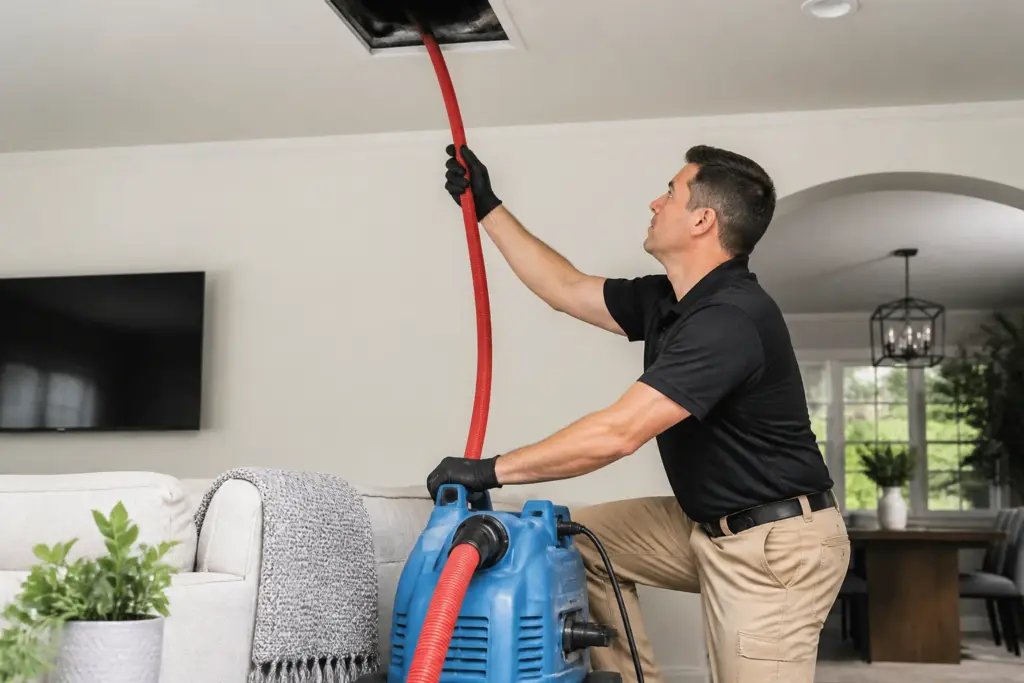
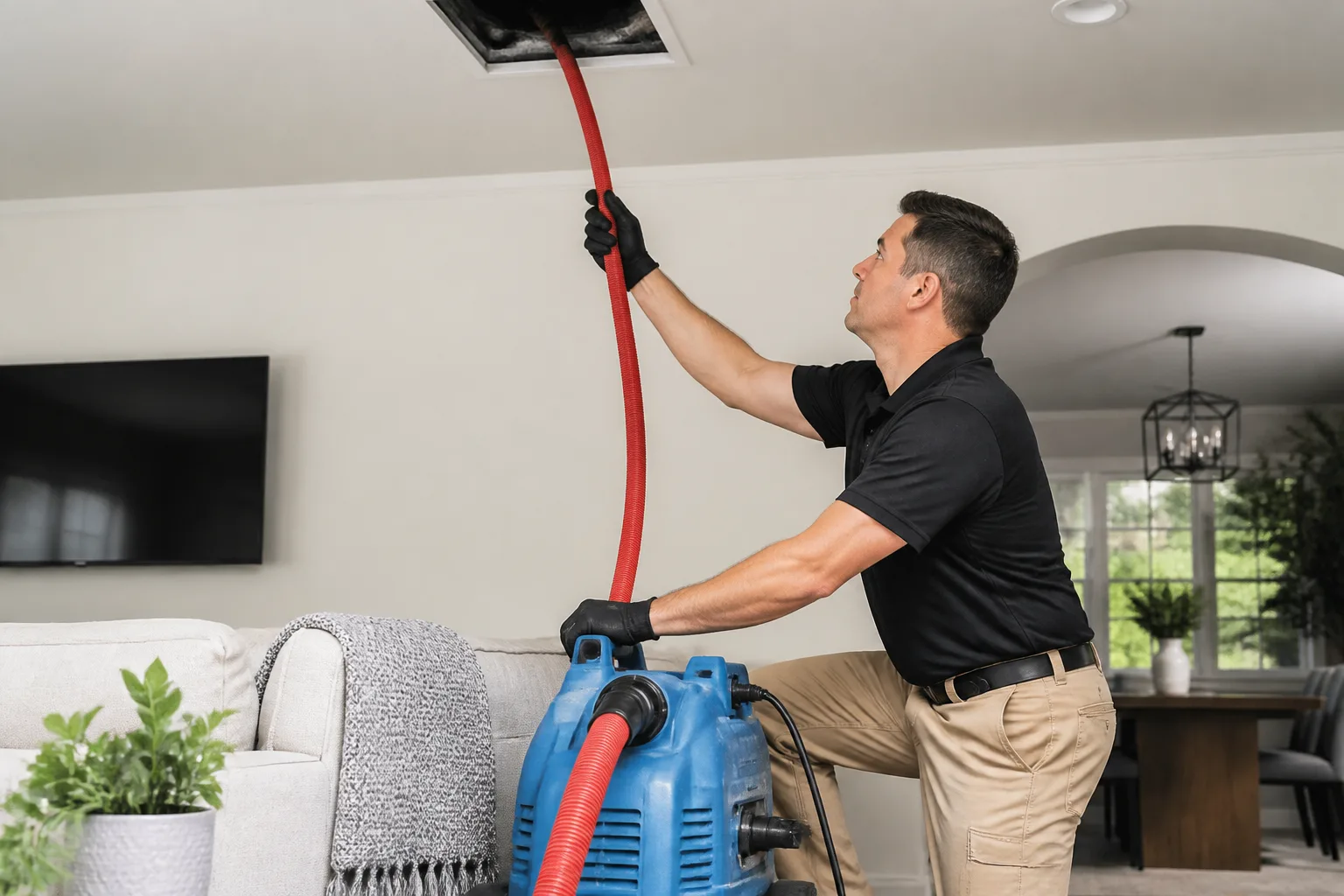
Agitation means physically dislodging the contamination from the duct walls. In our process, that’s the job of Rotobrush equipment: rotary-contact brushes that spin against the interior surfaces of the ductwork and break loose what’s adhered there. A shop vac with an extension hose cannot do this. It doesn’t have the mechanical action required to separate dried sewage particulate or rodent droppings from the duct wall.
Extraction means capturing the loosened material so it doesn’t re-enter your living space. This is where HEPA-rated filtration matters. Nikro extraction units filter the air down to a standard that traps the fine particulates most dangerous to breathe. A standard vacuum with a paper filter will circulate more of the contaminant back into the room than it captures. In a contamination scenario, that’s the opposite of cleaning.
Treatment means applying an antimicrobial agent to the cleaned surfaces to address bacteria and fungal spores left behind. After extraction, the ducts are physically clean, but they are not sanitized. A proper emergency response includes an antimicrobial application specific to the type of contamination. In cases involving sewage or rodent intrusion, this step is non-negotiable. And a real emergency job ends with documentation: a written report describing what was found, what was done, and what the system looked like afterward. If a company won’t provide that, call someone else.
Containment: The Step Most Companies Skip
During a contamination cleaning in any Castro Valley neighborhood, from the hillside homes near Lake Chabot to the flats around Castro Valley Boulevard, the biggest risk is cross-contamination. You’re cleaning a system full of sewage particulate or rodent droppings. The last thing you want is that material migrating into the living room during the process.
This is where negative-pressure containment comes in. Abatement Technologies units create negative air pressure inside the duct zone during cleaning. That means air flows into the containment area but not out of it. Loose particulates get pulled toward the extraction point instead of drifting into adjacent rooms. Without negative pressure, every brush stroke and every extraction pass pushes some portion of the contaminant out through register openings and into the home.
Ask any company you’re considering for an emergency cleaning one simple question: “What do you use for containment during the job?” If they pause, or say something vague about plastic sheeting, that’s your answer. Proper containment is active, not passive. It requires equipment, not just tarps. This is the single biggest difference between a company equipped for real emergency work and one that’s hoping for a quick invoice.
How to Verify a Company Can Handle Your Emergency
You’re calling about sewage in your ducts or a dead rodent in the return. You don’t have time for a company that treats this like a routine tune-up. Before you book, ask these questions. A legitimate provider in Castro Valley will answer all of them without hesitation:
- What agitation equipment is on your truck right now? The answer should be specific. “Rotary brush system” or “Rotobrush” is a good sign. “Some brushes and stuff” is not.
- Is your extraction unit HEPA-rated? If the answer is anything other than yes, keep looking. For contamination work, HEPA filtration is the minimum standard.
- How do you contain the work area during cleaning? Listen for a description of negative-pressure containment. “We put down drop cloths” is the wrong answer.
- Do you apply antimicrobial treatment after extraction? For water, sewage, rodent, or smoke contamination, this should be an automatic part of the scope, not an upsell.
- Will I get a written report after the job? You should get a document describing the condition found, the work performed, and the post-service state of the system.
If the company passes all five questions, book the job. If they stumble on more than one, call someone who didn’t. Your ducts are not the place to test a company’s improvisation skills.
The First 24 Hours After an Emergency Cleaning
Once the cleaning is done and the antimicrobial treatment has been applied, expect the HVAC system to behave a little differently for the first day. Run the system continuously for a few hours after the crew leaves, even if the weather in Castro Valley doesn’t demand it. This pushes residual moisture out of the ductwork and helps the antimicrobial treatment dry and set properly on interior surfaces.
You may notice a mild scent for the first day or two. That’s the antimicrobial agent doing its work, and it should fade quickly. If the smell is strong, acrid, or gets worse after 48 hours, call the company back. A properly executed treatment should not leave behind a persistent chemical odor.
Watch for any return of the original symptom. If the odor that triggered the emergency starts creeping back within a week, something was missed. That’s not always a sign of a bad job. In older Castro Valley homes with complex duct layouts, a secondary access point sometimes needs a follow-up visit to reach an area the first cleaning couldn’t fully address. A reputable company will return and finish the work.
Most importantly, change your HVAC filter immediately after an emergency cleaning, then again 30 days later. The first filter catches what the extraction process loosened but didn’t capture during the main pass. The second catches what kept circulating in the days after service. Use a high-MERV filter if your system can handle the airflow restriction. If you have a whole-home filtration system from Honeywell or Aprilaire, confirm that the media is fresh and the unit is running normally.
When the “Emergency” Turns Out to Be Something Else
Sometimes the urgent-sounding problem in a Castro Valley home turns out to be a mechanical issue rather than contamination. A burning smell when the heat first kicks on in autumn is often dust on the heat exchanger burning off, not an emergency. A rattling sound behind the wall near a register might be a loose duct connection, not a rodent. Musty air that appears only when the AC runs could be a condensate drain issue rather than mold in the ducts.
This is why the initial phone conversation matters. A good company asks questions before dispatching a crew. What does the smell resemble? When did it start? Does it happen only when the system runs, or all the time? Is there visible material at the register, or is it just an odor? The answers steer the response. They determine whether you need emergency extraction or a scheduled diagnostic visit with an emphasis on dryer vent cleaning and general system evaluation.
And before we forget: if you haven’t had your dryer vent cleaned in the last year, that’s a fire-risk checklist item, not an upsell. A clogged dryer vent causes thousands of residential structure fires every year. It’s a separate issue from your ducts, but it lives in the same house and deserves the same level of attention. If we’re in your Castro Valley home anyway, asking about the dryer vent is part of a complete evaluation.
Why Immediate Action Matters for Contamination, Not Just Cleanliness
When homeowners in Castro Valley hear “emergency duct cleaning,” some picture a truck arriving with sirens. That’s not how it works. What actually happens is a scheduled same-day or next-day dispatch, fast dispatch from 7am to 7pm Sunday through Friday, with equipment and a plan matched to the specific contamination. The urgency isn’t theatrical. It’s practical.
Contaminants inside ductwork don’t sit still. The blower moves air through the system every time the heat or AC runs. A rodent carcass in the return plenum distributes odor and biological particulate throughout the house with every cycle. Sewage in a floor register puts bacteria-laden air into the room where that register sits, then pulls it back through the system and spreads it everywhere else. The longer the system runs, the wider the distribution. That’s the case for shutting it down immediately and scheduling service quickly.
It’s also the case for hiring a company that treats this work as a whole-system job. Clean ducts are the start. Sealed, intact ducts are the finish. If the contamination entered through a breach in the ductwork, cleaning alone leaves the door open for it to happen again. That’s why Castro Valley homes with older ductwork often need a repair scope alongside the cleaning. The cleaning handles what’s inside. The repair handles what let it get inside in the first place.
The Bottom Line
An emergency air duct cleaning in Castro Valley comes down to three decisions made in the first hour. First, shut the system off. Second, determine whether you have a true contamination event or an alarming-but-routine condition. Third, call a company that can answer specific questions about agitation, HEPA extraction, and containment. Get those three right and the rest of the process is straightforward: antimicrobial treatment if contamination was present, documentation of the work, a filter change, and a follow-up if anything looks off in the days after service.
If you’re in Castro Valley and need help, Duct Cleaning Castro Valley offers free estimates. Call (855) 382-9257. We answer 24/7. Fast dispatch from 7am to 7pm, Sunday through Friday.
Frequently Asked Questions
A true duct emergency involves water, sewage, confirmed rodent activity, or smoke contamination inside the ductwork. If any of those conditions are present, shut your HVAC system off and call for same-day service in Castro Valley. Smells, dust, and allergy flare-ups without a known contamination source are usually scheduled-service issues, not emergencies. Call (855) 382-9257 and describe what you’re seeing if you’re unsure.
No. Household vacuums lack the filtration and reach needed to remove contamination from inside ductwork, and attempting it can spread the material into your living space. Duct deodorizer sprays mask smells without removing the source. A proper emergency response requires rotary agitation, HEPA-rated extraction, and antimicrobial treatment using professional equipment. For a free estimate in Castro Valley, call (855) 382-9257.
A true contamination cleaning in a typical Castro Valley home takes several hours, depending on the size of the system and the extent of the contamination. Smaller systems with a single affected area may be done in two to three hours. Whole-house contamination with antimicrobial treatment can take most of a day. The company you call should give you a realistic time window before dispatching a crew.
Ask what agitation equipment they use (look for a rotary brush system like Rotobrush), whether their extraction unit is HEPA-rated, how they contain the work area (negative pressure is the standard), whether antimicrobial treatment is included, and whether you’ll receive a written report afterward. If they can’t answer all five questions clearly, call a different company in Castro Valley.
Written by the team at Duct Cleaning Castro Valley, serving Castro Valley since 2012.
Need Air Duct Cleaning Help?
Call Duct Cleaning Castro Valley - licensed & insured, here with fast help in Castro Valley.
(855) 382-9257